
Our Technology
Integrated CNT Technologies (ICT) develops high-purity, application-ready single-wall carbon nanotube materials for research and emerging technologies.
Single-wall carbon nanotubes (SWCNTs) have extraordinary electronic, optical, and mechanical properties. But nanotube synthesis produces a mixture of many different nanotube structures.
These structures - known as chiralities - can have substantially different electronic and optical properties. A single as-produced material may contain metallic and semiconducting nanotubes with different diameters and bandgaps.
For many advanced applications, controlling this molecular level structure is essential.
Integrated CNT Technologies develops purification and processing technologies that transform heterogeneous nanotube feedstocks into precisely controlled materials for research and emerging technologies.
Chirality Separation
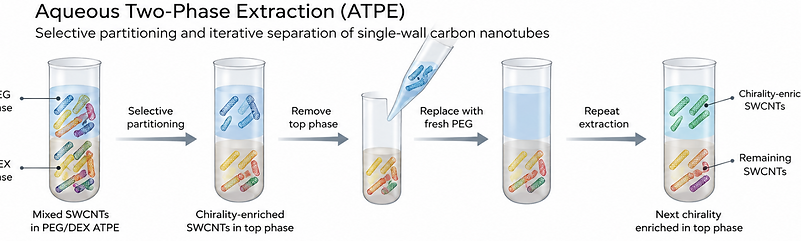
ICT's core purification platform is based on aqueous two-phase extraction (ATPE), a highly selective liquid-phase separation technique for single-wall carbon nanotubes.
Small differences in nanotube structure alter interactions between the nanotube surface, surfactants, and the surrounding solution. ATPE exploits these differences to partition nanotubes between two immiscible aqueous phases.
Through controlled, iterative separation, individual nanotube chiralities can be enriched from complex starting mixtures.
ICT holds an exclusive license to National Institute of Standards and Technology (NIST) intellectual property related to ATPE purification of single-wall carbon nanotubes and is developing this technology toward reproducible production of application-ready nanotube materials.

UV-Vis Absorbance Spectra of (6,5), (6,4) and (9,1) SWCNTs isolated from as-produced SWCNT material.
Data: ICT products
More Than Chirality
Selecting the correct nanotube chiral structure is only one part of producing a useful material. Some applications may require very high semiconducting purity, nanotubes of a specific length, or chiral handedness. By controlling the dispersant (DNA vs surfactant blends) oxidation state, and composition of the ATPS phases, other modalities of purification are possible.
ATPE can also be used to sort SWCNTs by:
-
Electronic type — separation of semiconducting and metallic nanotubes
-
Chiral handedness — selection of right-handed and left-handed nanotubes
-
Length — control of nanotube length distributions for device processing
ICT is developing an integrated purification and processing platform to control these characteristics rather than treating nanotube separation as an isolated step.

Separation of a SWCNT mixture (right) into blue semiconducting and yellow metallic fractions (left)
Photo credit: ICT
From Aqueous Purification to Application-Ready Materials
Many of the most powerful methods for separating carbon nanotubes operate in aqueous surfactant systems. The final application, however, may require something very different.
A biological sensor may require nanotubes wrapped by a particular DNA sequence. A semiconductor process may require exceptionally low ionic contamination, controlled nanotube length, and compatibility with an organic solvent or polymer dispersant.
ICT develops the post-purification processing needed to bridge this gap.
Our work includes technologies for purification, length control, removal of processing residues, surface-chemistry exchange, concentration, preservation, and transfer of purified nanotubes into application-compatible formulations.

Replacement of surfactant (sodium deoxycholate) with specific DNA needed for bio-sensing. The E11 transition peak shifts from 1033 to 1041 nm.
Data: ICT products
A Platform for Advanced Applications
The ability to independently control nanotube structure and wrapping/dispersant opens opportunities across multiple fields:
Nanoelectronics
High-purity semiconducting nanotubes with controlled chirality and length for transistors, integrated devices, and next-generation electronic materials.
Optics and Photonics
Chirality-selected nanotubes provide defined absorption and near-infrared emission wavelengths for optical research and photonic technologies.
Chemical and Biological Sensing
Combining chirality-purified nanotubes with selected surface chemistries enables fluorescent nanosensors whose optical response can be tailored to specific molecular environments.
Fundamental Research
Well-defined nanotube populations allow researchers to investigate intrinsic nanotube properties without the complexity of heterogeneous starting materials.